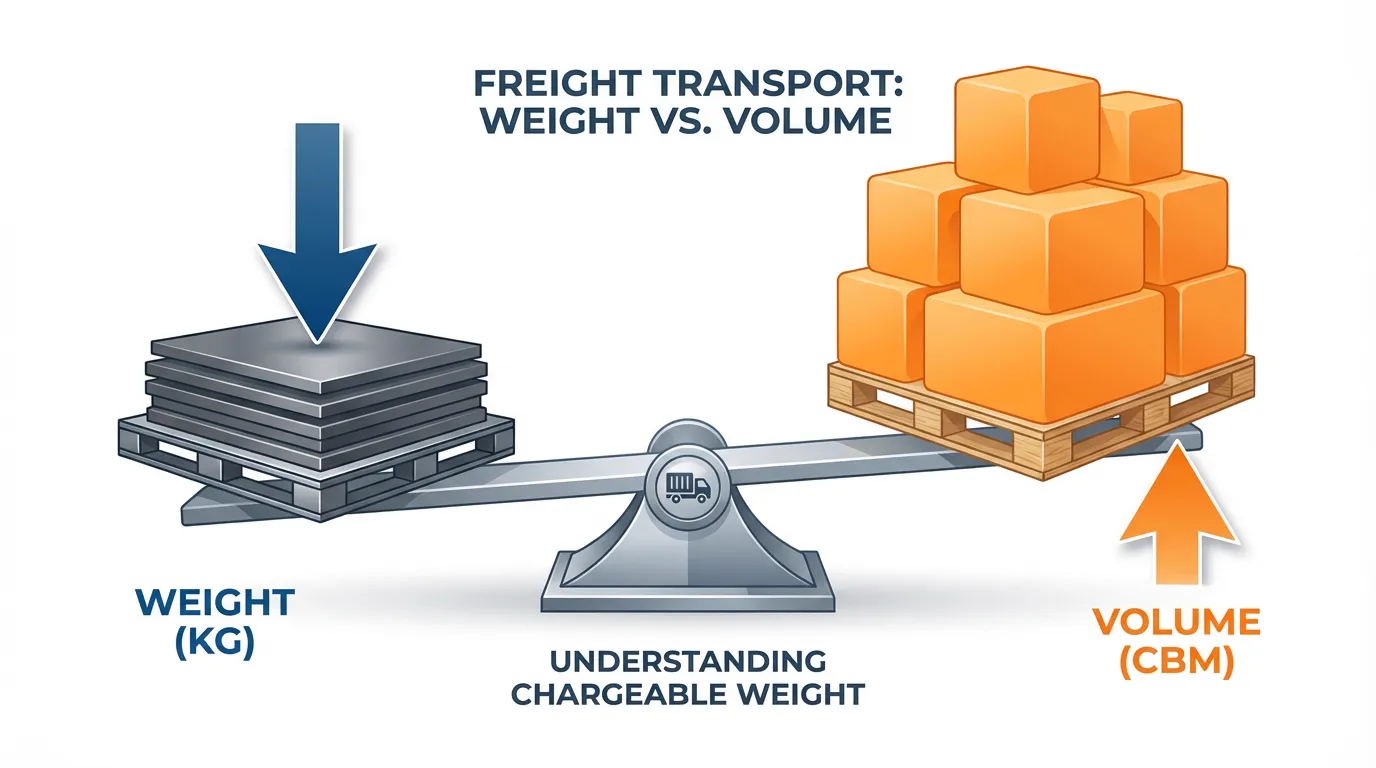
Two Dimensions of Freight
Every freight quote is built around two parameters: the actual weight of the cargo and the space it physically occupies inside the vehicle. The problem is that these two rarely move in proportion. A light, bulky shipment blocks trailer floor space just as effectively as a dense, compact one, but a purely weight-based rate would leave the carrier undercompensated for the space consumed.
That is why the industry uses volumetric weight (also called dimensional weight or, in German, Volumengewicht). It converts the cargo's cubic size into a fictitious weight, allowing a direct comparison with the actual weight. The carrier then charges based on whichever is higher.
What Is Volumetric Weight?
Volumetric weight is a calculated figure that represents how heavy a shipment would be if it were packed to the standard density used as a reference in that transport mode. If your cargo is large but light, the carrier treats it as though it weighed the volumetric equivalent, because that is the capacity cost it imposes on the vehicle.
The final billing basis is called chargeable weight: the higher of actual weight and volumetric weight. This single number determines your freight cost.
The Formula
The divisor varies by transport mode:
Air freight: Volumetric weight = (L × W × H in cm) / 5000
Road freight: Volumetric weight = (L × W × H in cm) / 3000
The result is in kilograms. The divisor 5000 follows the IATA standard for air cargo. The divisor 3000 is used by most European road carriers and couriers for palletised or parcel shipments.
Example: a pallet measuring 120 × 80 × 150 cm with an actual weight of 200 kg.
Volumetric weight (road) = (120 × 80 × 150) / 3000 = 1,440,000 / 3000 = 480 kg
Volumetric weight (480 kg) exceeds actual weight (200 kg), so the freight is charged on 480 kg. The cargo is too light for the space it occupies.
The Breakpoint: When Weight Wins and When Volume Wins
The crossover point is called the stacking factor or density threshold. For road freight it is typically 333 kg/m³ (derived from the divisor 3000). For air freight it is 167 kg/m³ (divisor 5000).
- If your cargo density is above the threshold, you pay on actual weight.
- If your cargo density is below the threshold, you pay on volumetric weight.
Stainless steel sits around 7,900 kg/m³. Ceramic tiles are 1,800-2,200 kg/m³. Upholstered furniture is 80-120 kg/m³, and polyurethane foam can be as low as 20-40 kg/m³. The pattern is clear: dense goods pay by weight, bulky goods pay by volume.
Practical Examples
| Cargo | Actual weight | Volume | Vol. weight (road) | Charge basis |
|---|---|---|---|---|
| Upholstery foam (1 EUR pallet, 150 cm high) | 40 kg | 0.144 m³ | 144 kg | Volume (144 kg) |
| Flat-pack furniture (1 EUR pallet, 180 cm high) | 120 kg | 0.173 m³ | 173 kg | Volume (173 kg) |
| Ceramic tiles (1 EUR pallet, 100 cm high) | 800 kg | 0.096 m³ | 96 kg | Weight (800 kg) |
| Steel sheets (1 EUR pallet, 60 cm high) | 1,200 kg | 0.058 m³ | 58 kg | Weight (1,200 kg) |
| White goods / appliances (1 EUR pallet, 160 cm high) | 280 kg | 0.154 m³ | 154 kg | Weight (280 kg) |
How This Plays Out in FTL vs LTL
In FTL (full truck load), the carrier prices the entire run as one job. You rent the vehicle from A to B regardless of what is inside, subject to the maximum payload (typically 24,000 kg for a standard trailer) and available LDM. Volumetric weight rarely appears in FTL pricing.
In LTL / groupage, every pallet or consignment is priced individually and the carrier manages a mix of cargo from different shippers. Here the chargeable weight rule is applied consistently to ensure fair revenue whether the load is heavy or bulky.
What This Means for You as a Shipper
Understanding chargeable weight prevents unwelcome invoice adjustments. If you quote only the actual weight of a bulky shipment, expect the carrier to recalculate. Before placing a booking, always compute the volumetric weight and check which figure is higher.
Pro tip for LTL shipments: always provide three data points - actual weight, dimensions (L x W x H), and the number of pallets or pieces. This eliminates ambiguity and speeds up quoting.