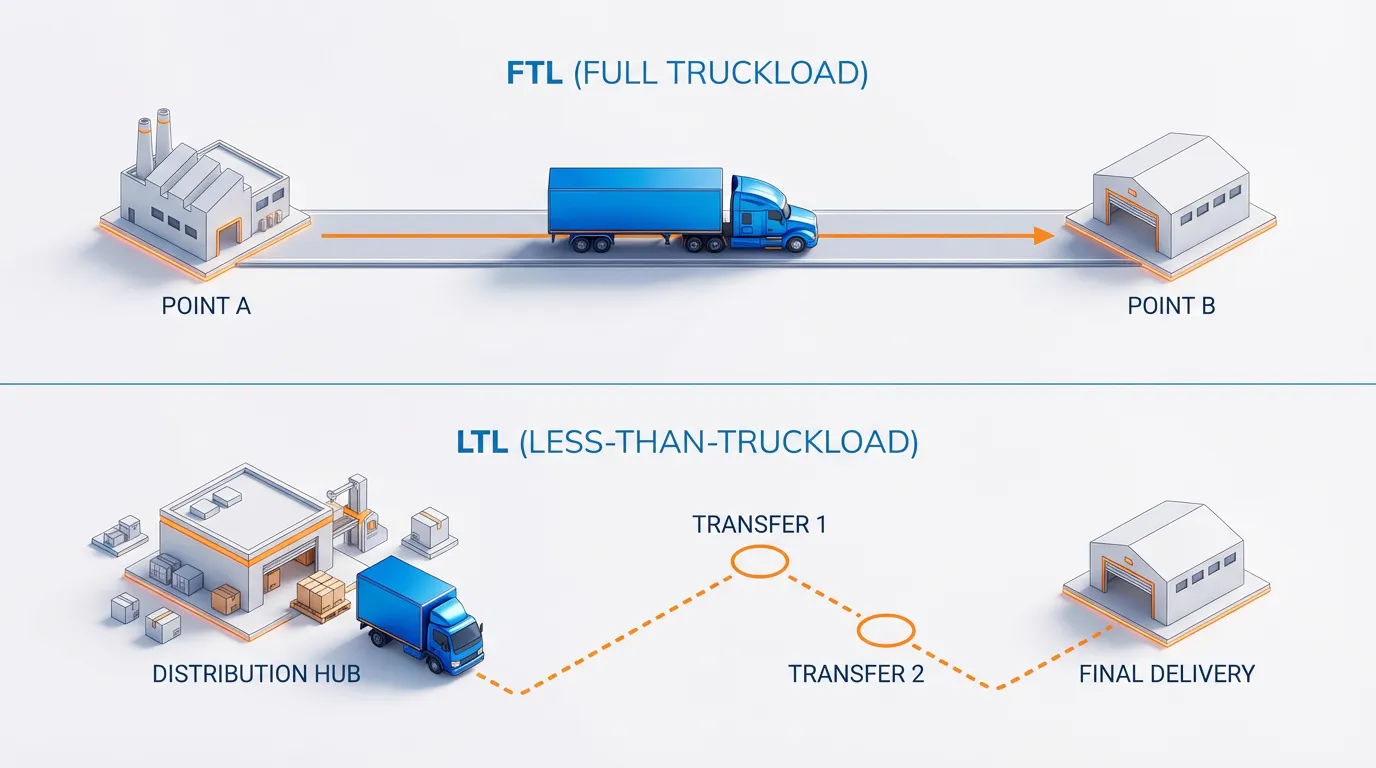
FTL and LTL - definitions
FTL (Full Truck Load) means a dedicated truck from one sender to one receiver. The driver goes directly from the loading point to the delivery address with no intermediate stops or reloading.
LTL (Less Than Truckload), also known as groupage or part-load shipping, means your cargo shares trailer space with shipments from other senders. The carrier consolidates loads at a hub terminal, distributing the costs across multiple consignors.
How pricing works
The pricing structure is fundamentally different between the two options, and this difference drives the break-even point.
With FTL you pay a fixed rate for the entire truck regardless of how much space you actually use. Whether you load 6 LDM or 13.6 LDM on a Warsaw to Hamburg run, the price stays the same. The unit cost per LDM falls as your volume grows.
With LTL the price is charged per loading meter (LDM) or per pallet. Every additional pallet adds a proportional charge. Beyond a certain volume threshold, the combined LTL rate catches up with the FTL price and then exceeds it.
Transit time - critical for planning
FTL is a direct service. The driver goes from A to B without unnecessary stops. Typical transit time on European routes is 1-2 working days.
LTL requires consolidation and deconsolidation at hub terminals. Your shipment may pass through one or several intermediate terminals before reaching the consignee. Standard transit time is 3-5 working days, and for more remote destinations it can be longer.
Risk of damage and delays
Every transfer is an additional risk event. In groupage transport, a shipment is handled multiple times: at the sender, at the consolidation hub, at the destination hub and at the final delivery. With four or five handling operations, the statistical probability of damage is higher than with the single load and unload sequence of FTL.
Delays in LTL are cumulative. If one shipment in a consolidated load misses the hub window, the entire batch may wait for the next available slot. In FTL, delays arise only from factors specific to that route: traffic, border crossings, or vehicle breakdown.
Cargo insurance - FTL vs LTL
The carrier's liability in international road transport is governed by the CMR Convention. The compensation limit is 8.33 SDR per kilogram of gross weight (in April 2026 this works out to approximately 9.75 EUR/kg at a rate of 1 SDR ≈ 1.17 EUR, check the current rate at imf.org). On paper there is no difference between FTL and LTL - the limit is identical.
In practice the difference is significant. With FTL you have one carrier, one CMR document, one chain of liability. If goods arrive damaged, you know who is responsible and on what basis.
With LTL the situation gets complicated fast. The shipment passes through several hands: the sender, the hub operator, the line-haul carrier, the second hub, the last-mile provider. When you open a carton at the consignee and see damage, you have to prove at which stage it occurred. That is rarely easy.
When to buy additional cargo insurance?
CMR does not cover the full value for light, high-value goods - electronics, apparel, cosmetics. If your shipment weighs 2,000 kg and is worth 80,000 EUR, the CMR cap is around 22,000 EUR. The gap is your loss.
For high-value cargo (above 5 EUR/kg) it pays to add a separate all-risk cargo policy. The premium is typically 0.1-0.3% of cargo value. For an 80,000 EUR shipment that is 80 to 240 EUR. With FTL you arrange one policy for one transport. With LTL you have to make sure the policy covers every leg, including hub transfers.
At how many LDM does FTL become cost-effective?
Every freight forwarder asks this question when planning a shipment. The answer depends on the specific lane and current market rates, but there is a practical industry rule of thumb:
Above 6-8 LDM, always compare the FTL price against the LTL quote.
At 6 LDM, the combined LTL rate often approaches half the FTL price. At 8 LDM, the difference is typically small or tips in favour of FTL. Above 10 LDM, FTL is almost always the cheaper option once you factor in handling surcharges, insurance and delay risk.
Decision matrix - when to choose FTL vs LTL
| Criterion | FTL | LTL (groupage) |
|---|---|---|
| Cargo volume | Above 6-8 LDM | Up to 6 LDM |
| Transit time | 1-2 days (direct) | 3-5 days (via hubs) |
| Pricing | Fixed per truck | Per LDM / pallet |
| Damage risk | Low (1 loading) | Higher (multiple transfers) |
| Fragile / high-value goods | Yes - recommended | No - higher exposure |
| Scheduling flexibility | High (on-demand) | Limited (collection windows) |
| Small shipments 1-3 pallets | Not cost-effective | Optimal |
When to choose FTL
- Your shipment exceeds 6 LDM, especially when you factor in handling and risk costs
- Goods are fragile or require special conditions (temperature control, ADR, low pressure)
- The delivery deadline is firm and the consignee cannot accept delays
- High cargo value - FTL insurance is simpler and typically less expensive
- You need full visibility: one driver, one vehicle, one CMR document
When to choose LTL
- Your shipment is up to 4-6 LDM and a full truck would be underutilised
- Goods are standard, robust and require no special handling conditions
- The delivery window is flexible and a few extra days make no difference
- You ship smaller volumes regularly and want to share costs with other senders
How to calculate the LDM of your shipment
Before you call a freight forwarder, calculate your loading meters. All you need are the dimensions of your pallets or crates:
LDM = (Length x Width) / 2.4
For example, 10 euro pallets (120 x 80 cm each) give 10 x 0.40 = 4.0 LDM. That shipment fits comfortably in LTL. But 20 euro pallets equal 8.0 LDM - at that point it is worth requesting an FTL quote, as it may be competitive or even cheaper.
Our free LDM calculator performs this calculation in seconds and helps you determine which transport option is optimal for your load.