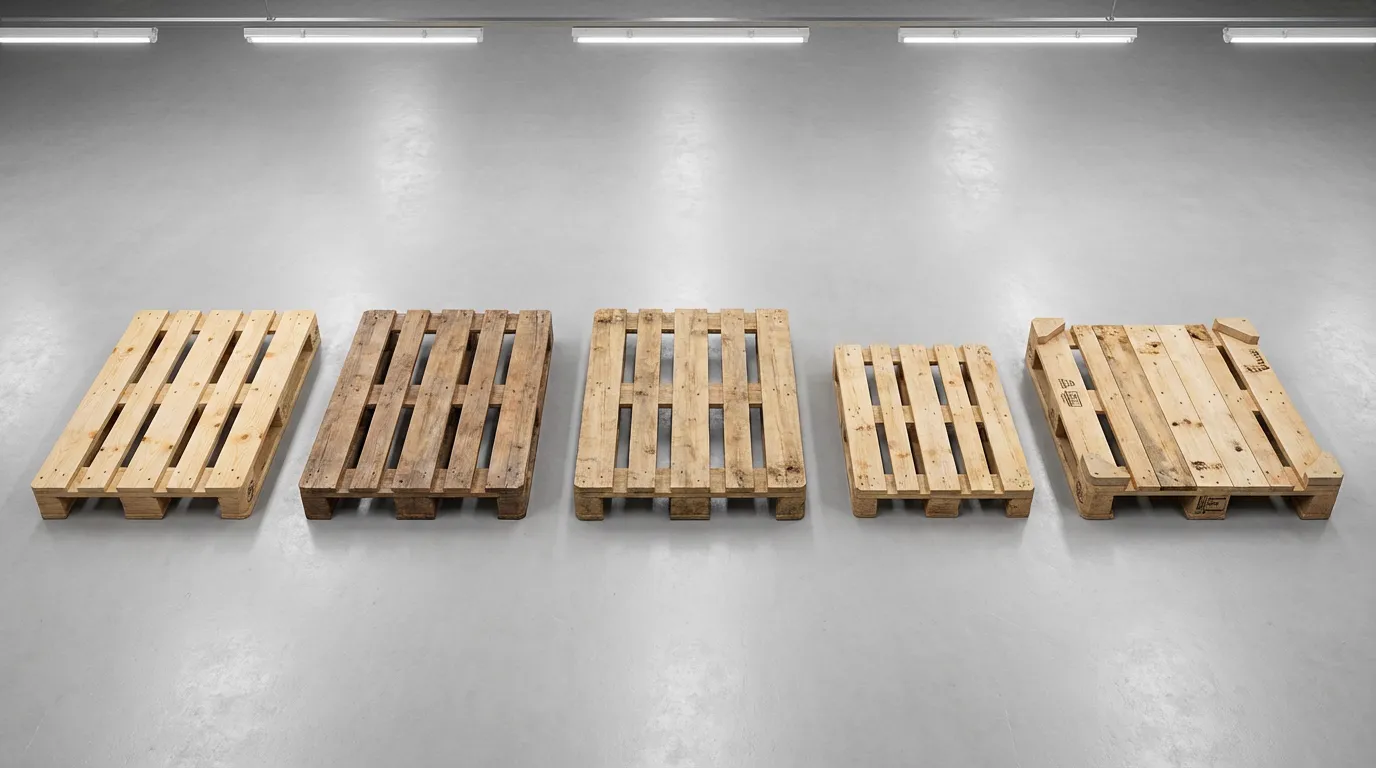
Choosing the right pallet type directly affects freight costs, loading efficiency and cargo safety. Several pallet standards coexist in European road transport, each differing in dimensions, load capacity and geographic prevalence. Here is a practical overview of the most important ones.
EUR / EPAL - Euro pallet (120 x 80 cm)
The Euro pallet is the dominant standard in European road freight. Produced and certified by the European Pallet Association (EPAL), it measures 120 x 80 cm with a dynamic load capacity of up to 1,500 kg (4,000 kg static). One loading meter equals 2.5 Euro pallets, and each pallet occupies 0.40 LDM.
A standard semi-trailer (13.6 m) accommodates 33-34 Euro pallets in a single layer. The Euro pallet is used in retail, food and beverage, chemicals, manufacturing and virtually every industry. It operates on a 1:1 exchange basis or within deposit systems between trading partners.
Geographic reach: all of Europe, with the highest density in Poland, Germany, France, the Benelux and Central and Eastern Europe.
Finnish / Scandinavian pallet (120 x 100 cm)
The Finnish pallet, also called the FIN pallet or Scandinavian pallet, measures 120 x 100 cm with a load capacity of up to 1,500 kg. It occupies 0.50 LDM. A trailer fits 26-27 pallets of this type.
The wider footprint (100 cm instead of 80 cm) provides better stability for goods with an uneven weight distribution. This pallet is the standard in Finland, Sweden, Norway and Denmark, and appears in Poland and the Baltic states for shipments originating from the Nordic region.
Typical applications: retail and wholesale trade in Scandinavia, food products, FMCG goods, machinery with irregular shapes.
Industrial pallet (120 x 120 cm)
The industrial pallet at 120 x 120 cm is square, which simplifies handling since no specific orientation is required. Load capacity reaches up to 2,000 kg, and it occupies 0.60 LDM. A trailer holds 22-23 pieces.
The larger surface area suits heavy or irregularly shaped industrial loads. It is used in chemicals, construction, metallurgy and for transporting machinery and technical components.
Geographic reach: Western Europe (Germany, Austria, Switzerland), heavy industry, machinery exports.
Half-pallet (80 x 60 cm)
The half-pallet, also known as a quarter pallet or display pallet, measures 80 x 60 cm with a load capacity of up to 500 kg. It occupies only 0.20 LDM. Theoretically, 66 half-pallets fit in a trailer, although the gross vehicle weight limit rarely allows a full trailer of this type.
The half-pallet is widely used in retail as a display unit placed directly on the shop floor without any further repacking. It fits supermarket aisles and shelving areas.
Typical applications: beverages, household chemicals, seasonal goods, promotional displays in retail chains.
UK pallet (120 x 100 cm)
The British pallet shares dimensions with the Finnish pallet - 120 x 100 cm - but is not the same unit. The two differ in construction, timber quality and certification standards. Load capacity is up to 1,000 kg, and LDM per pallet is 0.50.
Since Brexit, UK pallets require an ISPM 15 phytosanitary certificate for export to the EU, which adds complexity and cost to cross-Channel logistics. On the European continent, UK pallets appear primarily in connection with imports from Great Britain and Ireland.
Geographic reach: Great Britain, Ireland. In continental Europe as imports from the UK.
CP pallets - Chemical Pallet (chemical industry)
CP pallets (Chemical Pallets) are a family of pallets developed by the European chemical industry. Several sizes exist, with the most common being:
- CP1: 114 x 114 cm, load capacity 1,500 kg, 0.54 LDM
- CP2: 114 x 114 cm, load capacity 2,000 kg, 0.54 LDM
- CP3: 114 x 114 cm, load capacity 2,000 kg, 0.54 LDM
- CP9: 114 x 114 cm, load capacity 1,500 kg, 0.54 LDM
CP pallets are made from hardwood, are durable and circulate within closed exchange networks among chemical companies. They are used for transporting bags, drums, IBC containers and other industrial packaging.
Geographic reach: Western Europe, primarily Germany, Belgium, the Netherlands and France - chemical and petrochemical producers and receivers.
Stackability - key differences between pallet types
Not all pallets can be stacked in the same way. Euro pallets carrying FMCG goods with proper wrapping can be double-stacked in curtainsider trailers. Industrial pallets loaded with heavy goods are typically not stacked at all. CP pallets are engineered for warehouse stacking, but the cargo weight often prevents stacking in road transport.
When planning a load, consider:
- Maximum internal trailer height (typically 270 cm)
- Permitted gross vehicle weight (typically 24,000 kg of payload)
- Packaging type and cargo stability on the pallet
- Receiver requirements for unloading sequence
Pallet type comparison table
| Pallet type | Dimensions (cm) | Load capacity | LDM / unit | Max. per trailer | Main market |
|---|---|---|---|---|---|
| EUR / EPAL | 120 x 80 | 1,500 kg | 0.40 | 33 pcs. | All of Europe |
| Finnish pallet (FIN) | 120 x 100 | 1,500 kg | 0.50 | 27 pcs. | Scandinavia, Finland |
| Industrial pallet | 120 x 120 | 2,000 kg | 0.60 | 22 pcs. | Western Europe |
| Half-pallet | 80 x 60 | 500 kg | 0.20 | 66 pcs.* | EU retail |
| UK pallet | 120 x 100 | 1,000 kg | 0.50 | 27 pcs. | Great Britain, Ireland |
| CP pallet (CP1) | 114 x 114 | 1,500 kg | 0.54 | 25 pcs. | EU chemical industry |
* Gross vehicle weight limits reduce the actual pallet count for heavy cargo.
Which pallet type should you use?
The primary consideration when choosing a pallet is the receiver's requirements and the standard used in the destination country. The Euro pallet is the safe default for the majority of European routes and cargo types. If you are shipping to or from Scandinavia, you need to be prepared for Finnish pallets. For industrial and chemical shipments, always confirm the expected pallet format with the receiver before booking transport.
Knowing the LDM value of each pallet type allows you to calculate freight costs precisely and avoid surprises when quoting. Our LDM calculator supports all major European pallet formats.