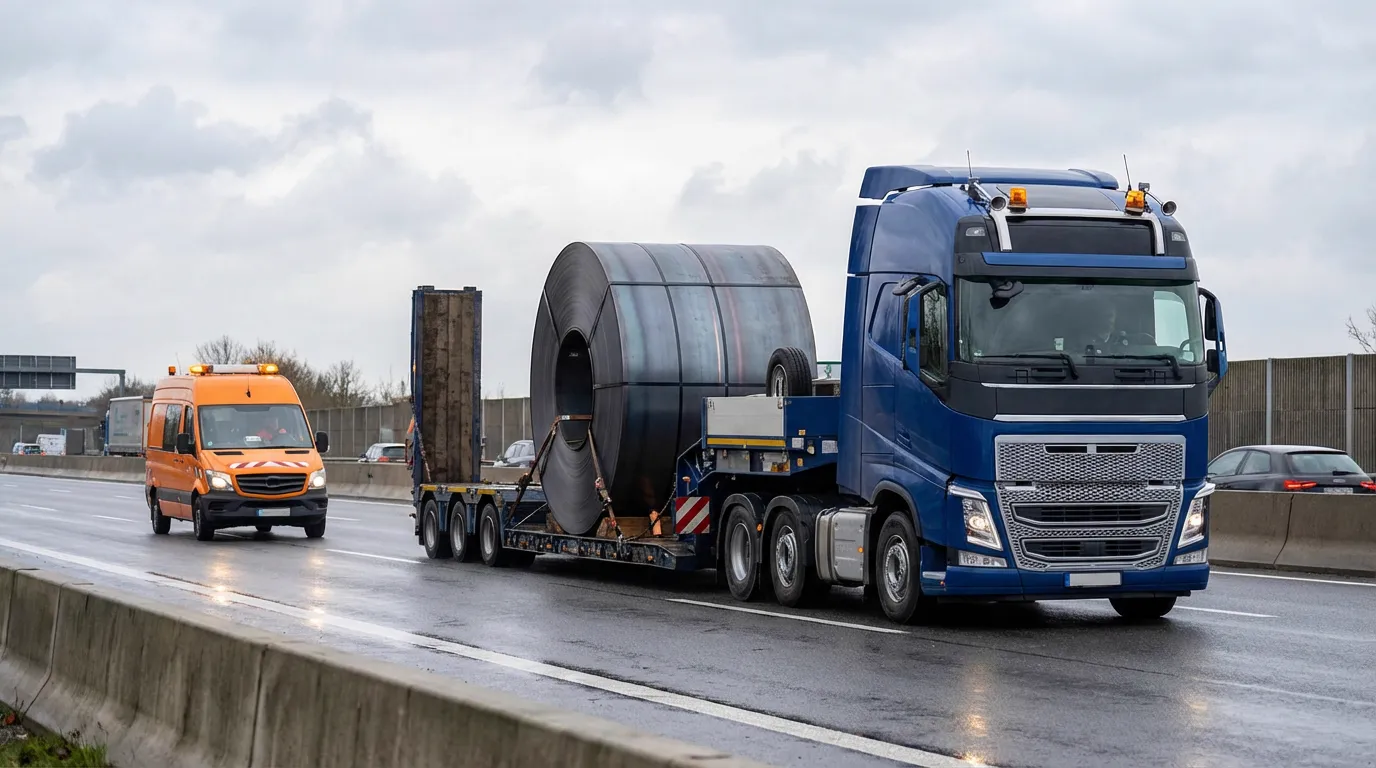
What counts as non-standard cargo?
Non-standard or oversized cargo is anything that exceeds the standard limits of a curtainsider or box trailer. Across Europe, the following parameters define the boundary of normal road transport:
- Cargo length: up to 13.6 m on a standard semi-trailer
- Width: up to 2.4 m (usable floor width of the trailer)
- Height: up to 2.7 m from trailer floor (total maximum 4.0 m from road level)
- Weight: up to 24,000 kg of cargo with a 40-tonne gross combination weight
Once your cargo exceeds any one of these parameters you move into the territory of abnormal transport. That means different vehicles, different administrative procedures, and a completely different cost structure.
Common categories of oversized cargo
Several types of goods regularly require specialist transport:
Steel coils
Hot-rolled and cold-rolled steel coils are among the most frequent oversized loads in European transport. Typical parameters:
- Unit weight: 5,000 - 25,000 kg
- Outer diameter: 1.2 - 2.1 m
- Width: 0.6 - 2.0 m
They require flatbed platforms with coil wells or lowbed trailers with appropriate securing. A coil weighing more than 10 tonnes on a single axle requires load distribution across multiple support points.
Industrial machinery and equipment
Presses, machine tools, turbines, transformers, generators - industrial equipment frequently does not fit within standard trailer dimensions. The most common challenges are high dead weight (power transformers: 20,000 - 300,000 kg) and irregular shapes that complicate loading and require axle load analysis.
Non-standard containers and tanks
A standard 20-foot container fits within the weight limit, but pressure vessels, chemical reactors and silos often exceed the permitted width or height. A tank with a 3.5 m diameter requires a special permit and an extendable trailer.
Long goods: pipes, beams, prefabricates
Steel pipes, lattice girders, foundation piles, wind turbine blades - all exceed the standard trailer length. Typical ranges:
- Pipes: 12 - 24 m
- Lattice girders: 15 - 40 m
- Wind turbine blades: 50 - 80 m
Trailer types for oversized transport
Lowbed (Tieflader)
A trailer with a lowered loading platform - typically 80-100 cm from the road surface instead of the standard 140 cm. This allows transport of tall loads without exceeding the 4.0 m total height limit. Ideal for construction machinery, agricultural tractors and large industrial equipment. Standard payload: up to 60,000 kg.
Extendable trailer (telescopic)
A flatbed whose length can be extended from the standard 13.6 m to 28 m or more. Used for pipes, beams and precast concrete elements. Lengths above 16.5 m usually require an escort vehicle.
Flatbed
An open platform without walls or roof. Allows loading from the side and above, which is essential for irregular shapes. Standard payload: up to 24,000 kg. For heavier loads, a reinforced or multi-axle flatbed is used.
Coil trailer
A specialised flatbed with profiled recesses (coil wells) for transporting steel coils. The recess lowers the coil's centre of gravity and prevents lateral movement. A standard configuration accepts 2-4 coils with a combined weight of up to 24,000 kg.
SPMT modules
Self-Propelled Modular Transporters are used for extremely heavy loads (above 200 tonnes). They are the standard solution for transformers, reactors and bridge structures.
Key factors in pricing
1. Weight and axle load distribution
The permitted axle load in most EU countries is 10,000 kg/axle or 11,500 kg/axle depending on the configuration. Exceeding this requires a permit. More axles spread the load better but increase vehicle cost - the carrier will always factor this into the quote.
2. Dimensions and route analysis
Every oversized route is checked individually for underpasses, tunnels, roundabouts, bridges and power lines. Narrow streets in city centres or industrial estates can force a detour of hundreds of kilometres, which is reflected in the price.
3. Permits
In most EU countries, oversized transport permits are issued by the national road authority. Categories typically cover:
- Category I: up to 3.2 m width, no escort required
- Category II-IV: up to 4.5 m width, various escort requirements
- Category V+: beyond standard categories, individually negotiated routes
Lead time for a permit ranges from one working day (lower categories) to several weeks (highest categories). This directly affects delivery time and total cost.
4. Escort vehicles
From 3.2 m width and lengths above 23 m, one escort vehicle is required. Above 4.0 m width or extreme dimensions, you need front and rear escorts plus a police escort. The cost of a single escort vehicle is 300 - 600 EUR per day, excluding the vehicle's own travel.
5. Time restrictions
Some permits allow transit only during daylight hours or off-peak traffic. Weekend transports are often prohibited on selected road sections. Time restrictions extend the delivery schedule and may add driver accommodation costs.
What does pricing look like in practice?
A freight forwarder quoting an oversized transport job needs at a minimum:
- Exact dimensions: length, width, height (with and without packaging)
- Total weight and centre of gravity position
- Loading and unloading addresses (GPS or full address)
- Required delivery date (time needed to obtain permits)
- Special requirements: lashing points, temperature, customs documentation
With this information the forwarder selects the vehicle, checks the route, calculates permit and escort costs, then submits the quote. Transport of a 15-tonne steel coil from Poland to Germany typically runs 1,200 - 2,500 EUR depending on route and vehicle class. Moving a 40-tonne machine with escort over 600 km falls in the range of 4,000 - 9,000 EUR.
LDM calculator and oversized cargo
A standard LDM calculator is designed for groupage and full truck load within normal limits. For oversized cargo it is a starting point - it tells you whether the load fits a standard trailer in terms of LDM and weight, or whether a specialist vehicle is needed. If your cargo exceeds 24,000 kg or 2.4 m in width, you know you need a separate quote from a specialist carrier.